


Most founders get this decision wrong — not because they’re careless, but because they’re comparing the wrong things.
They look at hourly rates and assume the agency is more expensive. Or they assume hiring in-house means more control. Sometimes both of those are true. Often, neither is. The real question isn’t which option costs more. It’s which one costs more for what you’re trying to do, right now, at your current stage.
I’ve seen early-stage companies burn through six months hiring two developers, only to realize they needed five different specialties and a project manager. I’ve also seen companies pay agency retainers for three years on work that would’ve been cheaper and faster in-house after month eight. There’s no universal answer here. But there is a framework that makes the decision a lot clearer.
What You’re Actually Paying For
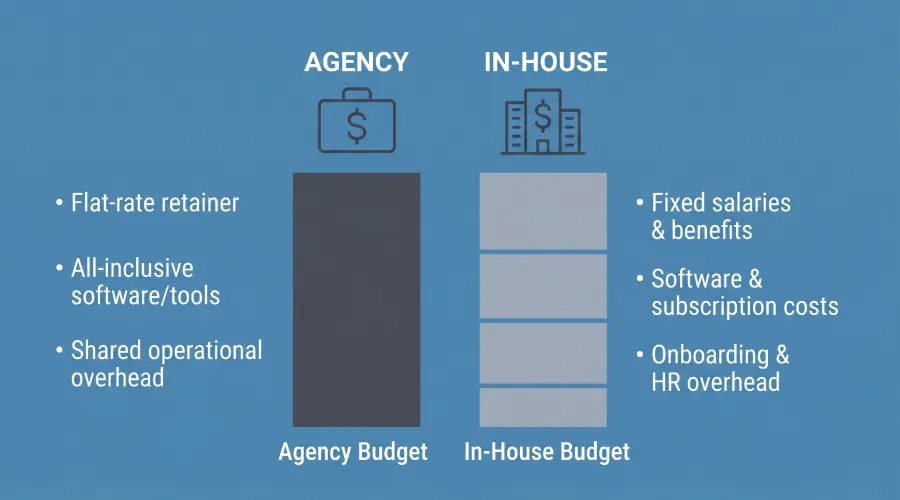
The Agency Model
When you hire a software agency, you're not renting warm bodies. You're buying a pre-assembled machine. The team already exists. The processes are already in place. The project manager, the architect, the QA lead — they've worked together before. You plug your project in and it starts moving.
That's the pitch. And honestly, for the right project, it holds up.
The cost is higher on paper. Agency rates in New York range from $125 to $275 per hour depending on the firm and the scope. A six-month engagement can run $150,000 to $400,000. That number sounds large until you price out what you'd spend hiring equivalent talent.
A senior full-stack developer in New York costs $140,000–$180,000 per year in base salary. Add benefits, payroll taxes, equipment, onboarding time, and the 30–90 days before they're actually productive, and you're looking at $200,000+ annually for one person. For a product that needs a designer, a backend engineer, a front-end engineer, and someone who understands data — you do the math.
Agencies also absorb the turnover risk. If a developer leaves your project, that's their problem to solve, not yours.
The In-House Model
In-house makes sense when your software is the product, or deeply embedded in how your business works every day.
If you’re building a SaaS platform that will be the core of your business for the next decade, at some point you need people whose entire professional focus is that product. They learn the codebase at a depth no external team will match. They’re in your Slack. They’re on your org chart. They care about your roadmap because it’s their roadmap.
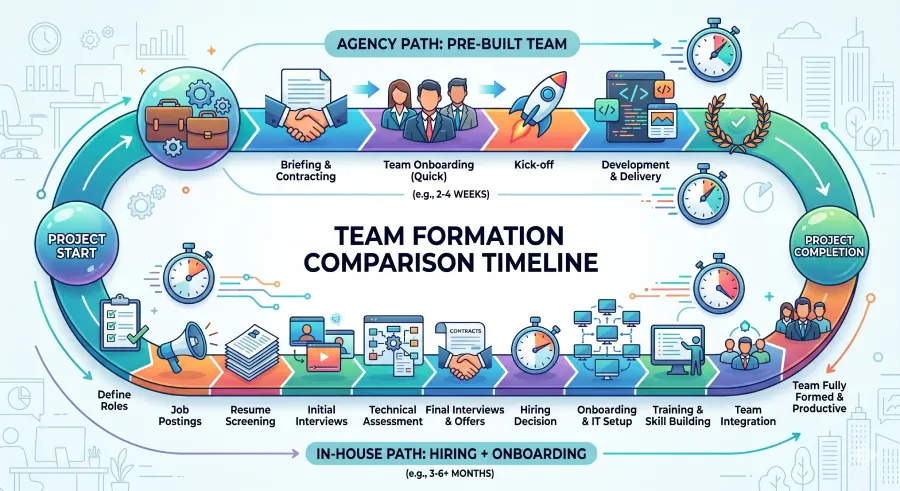
The tradeoff is time and overhead. Recruiting a strong engineering team takes months. Onboarding takes more months. Building internal engineering culture — the practices, the code review standards, the documentation habits — takes longer still. None of that is bad. It’s just real, and you need a runway for it.
Where Most Companies Get This Wrong
They treat it as a permanent choice.
It’s not. Most companies that get software right use both at different points. A common pattern: hire an agency to build version one, ship fast, validate the product. Then, once the business model is confirmed and revenue is coming in, start building an internal team to own the long-term codebase.
The other mistake is underestimating scope. Companies come in thinking they need “a simple app.” Six weeks in, it’s a complex system with integrations, custom logic, and edge cases nobody anticipated. Agencies can flex to match that complexity because they have the people. A two-person in-house team usually can’t.
The Honest Breakdown
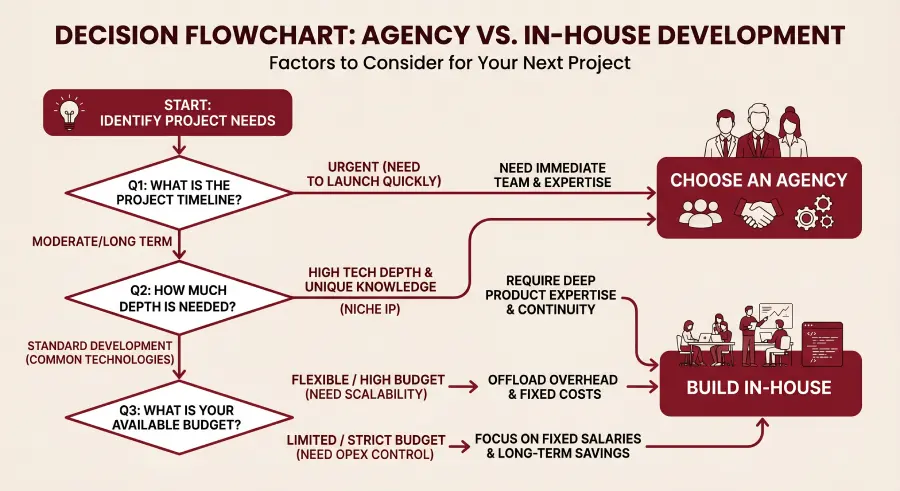
Go with an agency if:
- You need to ship in under six months
- Your technical requirements are complex or specialized (AI, cloud architecture, data pipelines)
- You don’t have an internal technical leader who can manage developers
- You’re validating a product before committing to headcount
- You need to scale team size up or down depending on the phase
Build in-house if:
- Your software is the core product, not a support tool
- You have a long runway and can afford the ramp-up time
- You need developers who will own the product long-term
- You already have a strong CTO or technical lead who can hire and manage well
- Your domain is specialized enough that institutional knowledge is the main asset
Honestly, both if:
- You’re past product-market fit and scaling fast
- You have specific features the agency builds, and core infrastructure the internal team owns
- You want speed on new features without pulling your team off existing systems
What to Ask Before You Decide
Before you sign anything or post a job listing, answer these honestly:
What’s your actual timeline? Not your ideal timeline — the one where the board is patient and users aren’t waiting. The real one. If it’s under six months, an agency almost always wins on speed.
Do you have technical leadership? Hiring developers without someone who can evaluate their work, review their code, and make architecture decisions is how projects go sideways. An agency brings that built in. In-house hiring without it is a risk.
How stable is your requirements list? If you’re still figuring out what you’re building, agencies handle ambiguity better — they’ve seen it before. If your spec is locked and the work is long-term, in-house starts to make more sense.
What happens after launch? Someone has to maintain the code. Update the dependencies. Fix the bugs that show up six months in. Who is that? If you don’t have an answer, your post-launch plan has a gap.
A Quick Note on “Control”
People say they want in-house because they want control. I get it. But control over what, exactly?
If it’s control over the code, you own that with a good agency too — the deliverable is yours. If it’s control over the process — the daily standups, the sprint planning, the roadmap — that’s a communication and contract question, not an in-house vs. agency question. Most agencies that work with mid-size companies are used to operating inside the client’s process.
The places where in-house genuinely gives you more control: long-term institutional knowledge, cultural fit, and the ability to make same-day decisions without a statement of work.
FAQ
Is it cheaper to hire an agency or build an in-house team?
Short-term, it depends on scope. For projects under 12 months, agencies often cost less than recruiting, onboarding, and employing full-time developers at New York rates. For long-term ongoing development, in-house usually becomes more cost-effective after 18–24 months.
Can I start with an agency and then transition to an in-house team?
Yes, and it’s a common pattern that works well. The key is ensuring your agency builds with clean, documented code that an internal team can take over without a complete rewrite. Ask about this before you engage.
What if I need both front-end and back-end expertise?
An agency gives you access to both in the same engagement. Hiring both specialties in-house simultaneously doubles the recruiting timeline and budget.
How do I know if an agency is a good fit?
Ask to see their process, not just their portfolio. How do they handle scope changes? What happens if a developer rolls off mid-project? What’s included in their QA process? The answers tell you more than case studies.
Does Guehi And Co work with companies at any stage?
We work with startups, growing businesses, and established companies — often at different phases of the same engagement. If you’re not sure what you need yet, a discovery call is a good first step.
Guehi And Co. is a New York-based software development agency. Since 2023, we’ve helped businesses across industries build software that actually fits how they work. If you’re weighing your options, we’re happy to talk it through.