

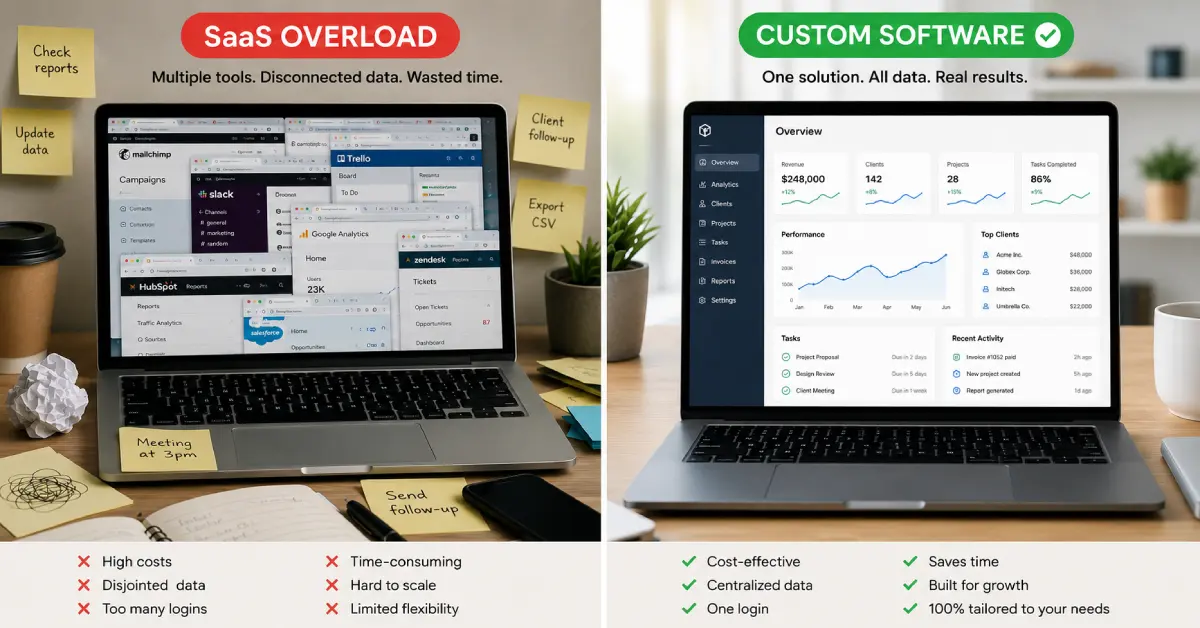
You sign up for a project management tool. Then a CRM. Then something for your HR team, something for invoicing, something for reporting.
Each one is $30/month. Each one solves a real problem. None of them talk to each other.
Eighteen months later, you have eleven subscriptions, four spreadsheets bridging the gaps between them, and a team that spends more time exporting and reformatting data than actually using it. And somehow, the monthly software bill is now north of $4,000.
This is the SaaS trap. And most businesses walk straight into it.
The number that should concern you
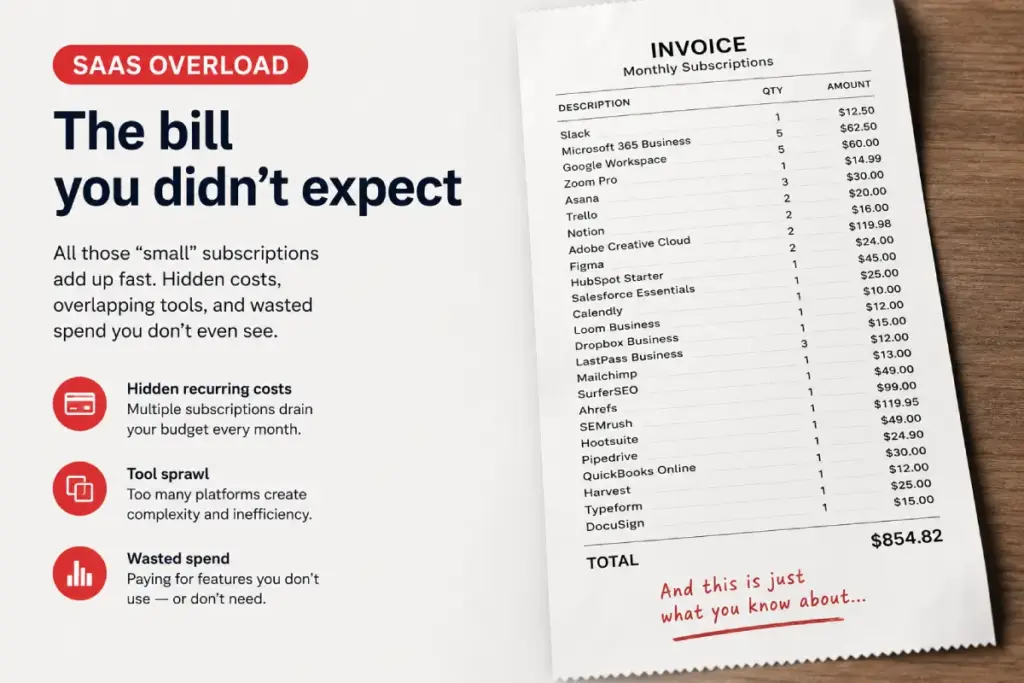
Nearly 40% of companies say they overspend on SaaS subscriptions without realising it, according to a Deloitte report cited in recent industry research. The average business ran over 100 SaaS applications by 2021 — up from just 8 in 2015.
That growth wasn’t planned. It happened tool by tool, team by team, each purchase individually reasonable, collectively a mess.
The subscriptions themselves are just the visible cost. The real drain is everything around them: the hours lost to manual workarounds, the data stuck in silos that won’t sync, the employee whose entire job is essentially moving information from one platform to another. That’s not efficiency. That’s expensive duct tape.
What off-the-shelf software is actually selling you
Off-the-shelf tools — whether SaaS subscriptions or packaged software — are built for the largest possible audience. That’s the whole business model. Design for the median use case, sell to everyone who fits within a few standard deviations of it.
Which works fine if your business is median.
Most businesses that have been operating for more than a few years aren’t. They’ve developed specific processes, specific workflows, specific ways of doing things that work for them. Off-the-shelf software either can’t accommodate those, or accommodates them with enough friction that people work around the software rather than through it.
The workarounds are where the money goes. Not in the subscription fee — in the labour cost of compensating for a tool that doesn’t quite fit.
The argument for custom software (and when it actually holds)
Custom software gets a reputation for being expensive. That’s fair at the start. Building something from scratch costs more upfront than a $49/month SaaS license.
But the comparison isn’t apples to apples.
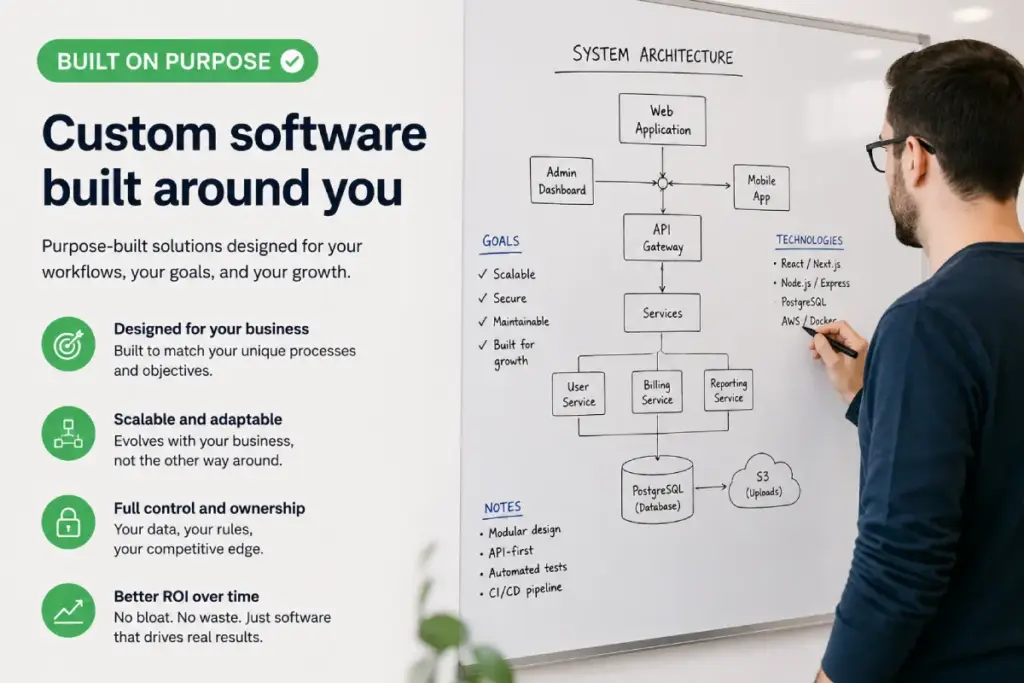
A custom internal tool, once built, doesn’t charge you per seat. It doesn’t increase your bill when you hire more people. It doesn’t sunset a feature you relied on. It doesn’t change its pricing model in a renewal email you almost missed.
The global custom software development market sat at around $43 billion in 2024. By 2030, projections put it near $146 billion — growing at roughly 22% annually. That’s not agencies selling businesses on vanity projects. That’s companies doing the math and deciding that owning their software makes more sense than renting tools that were built for someone else.
The honest version of the cost comparison
Say your business is paying for:
- A CRM: $200/month
- A project management tool: $120/month
- A reporting tool: $150/month
- An HR platform: $180/month
- Various add-ons and integrations: $200/month
That’s $850/month, $10,200 annually — for tools that partially overlap, don’t fully integrate, and require your team to maintain the connections between them manually.
A custom internal tool that handles the workflows currently spread across three of those platforms might cost $40,000–$70,000 to build. Expensive. But at $10,200 per year (not counting the labour cost of the workarounds), you’re looking at a 4–7 year break-even — and a system you actually own.
For businesses that plan to be around in five years, that’s not a bad trade.
So when does custom software actually make sense?
Not always. That’s worth saying directly.
If your needs are genuinely generic — standard invoicing, basic project tracking, off-the-shelf CRM — and your team fits comfortably within those tools, a SaaS stack is probably the right call. It’s faster to deploy, easier to maintain, and you benefit from the vendor’s ongoing development.
Custom software makes sense when:
Your process is the product. If the way your team operates is part of your competitive advantage, you probably don’t want to rebuild it inside a tool designed for the median competitor.
You’re paying for features you don’t use to get the ones you do. Most SaaS platforms bundle functionality. If you’re on a higher pricing tier specifically to access three features while ignoring the other forty, the economics stop making sense.
Integration is constant pain. If your team regularly moves data between platforms, builds Zapier workflows to connect tools that should talk natively, or maintains spreadsheets as a bridge between systems — you’re already paying for custom software. You’re just paying in engineer time rather than upfront development cost.
You’re scaling and the per-seat model is killing you. A tool that charges per user starts to look very different at 10 employees than at 80.
The build-vs-buy question, answered honestly
There’s a useful heuristic here: if the software touches the core of how your business creates value, consider building. If it’s infrastructure that any business of your type needs, buy.
Accounting software? Buy it. Everyone needs to send invoices.
The system that manages your client onboarding workflow, syncs with your project tracking, and triggers automated reports for your leadership team? That’s specific enough that building it starts to make more sense than stitching together four tools and hoping the integrations hold.
FAQ
How long does it take to build custom software?
Scope-dependent. A focused internal tool — say, a custom reporting dashboard or a client portal — can be built in 6–10 weeks. A full platform with multiple user roles and integrations takes 3–6 months. The discovery phase, where requirements are properly documented, is what keeps projects on timeline.
Is custom software hard to maintain after it’s built?
Less than people expect, if it’s built well. A clean codebase with proper documentation is easier to maintain than a SaaS integration that breaks every time the vendor pushes an update. Ongoing support retainers exist for exactly this reason.
What if my needs change?
That’s the advantage, not the risk. Custom software can be modified to match your business as it evolves. Off-the-shelf tools change when the vendor decides to change them — not when you need them to.
We’re a small business. Is this relevant to us?
Depends on the problem. Some small businesses have genuinely generic needs and a SaaS stack serves them well. Others have specific workflows from day one that no existing tool handles properly. The size of the business matters less than the specificity of the problem.
The practical takeaway
SaaS isn’t the enemy. Used well, a lean, well-chosen software stack is the right answer for a lot of businesses.
The problem is that most businesses don’t use SaaS well. They add tools reactively, never audit what they’re paying for, and end up with a stack that’s expensive, fragmented, and held together by spreadsheets and habits nobody wants to defend.
If you’re at the point where your software stack is creating more work than it removes, it’s worth asking whether the next move is another SaaS subscription — or a tool that was actually built for how you work.
Guehi And Co. builds custom software for businesses that have outgrown their off-the-shelf tools. If you’re not sure which side of that line you’re on, book a discovery call — we’ll tell you honestly.