


When building custom software, business leaders and product managers often hyper-focus on feature lists, launch timelines, and initial budgets. In doing so, they frequently overlook the most critical foundational decision of the entire project: the underlying technical architecture. Choosing the wrong technology stack might get a product out the door quickly, but it almost guarantees sluggish performance, frustrating user experiences, and crippling technical debt as your user base begins to grow.
Today, top-tier engineering teams are consistently abandoning rigid, monolithic systems in favor of a unified, highly dynamic JavaScript architecture—specifically leveraging React for the frontend and Node.js for the backend. When paired with agile databases and robust routing, this forms what the industry refers to as the MERN stack (MongoDB, Express.js, React, Node.js). But why has this specific ecosystem become the gold standard for custom software, SaaS products, and enterprise applications?
1. Uncompromising User Experience and Design Fidelity
Modern users have zero tolerance for slow, clunky interfaces. They expect business tools to feel as responsive and intuitive as the consumer apps they use every day. This is where React, originally developed by Meta, completely changes the game.
React utilizes a “Virtual DOM,” which allows web applications to update and render specific components instantly without reloading the entire page. Furthermore, React’s component-based architecture perfectly mirrors modern UI/UX design workflows. When designers build modular design systems and high-fidelity prototypes, our engineering team can translate those exact visual components directly into React code. This ensures pixel-perfect accuracy, meaning the software your users interact with looks and behaves exactly like the polished designs you approved. The result is a fluid, interactive software environment that drastically improves user retention and adoption rates.
2. The Power of Asynchronous Backend Engineering
A beautiful frontend is useless if the server crashes under pressure. Node.js is engineered specifically to handle modern web traffic. Unlike older backend languages that process requests sequentially (forcing users to wait in line), Node.js operates on a non-blocking, event-driven architecture.
This means it can handle tens of thousands of concurrent connections simultaneously without breaking a sweat. When combined with Express.js—a minimalist, lightning-fast web framework—Node.js becomes incredibly adept at building robust RESTful APIs. Whether your application needs to process real-time logistics tracking, handle complex financial calculations, or manage high-volume e-commerce transactions, this backend setup scales horizontally with remarkable efficiency.
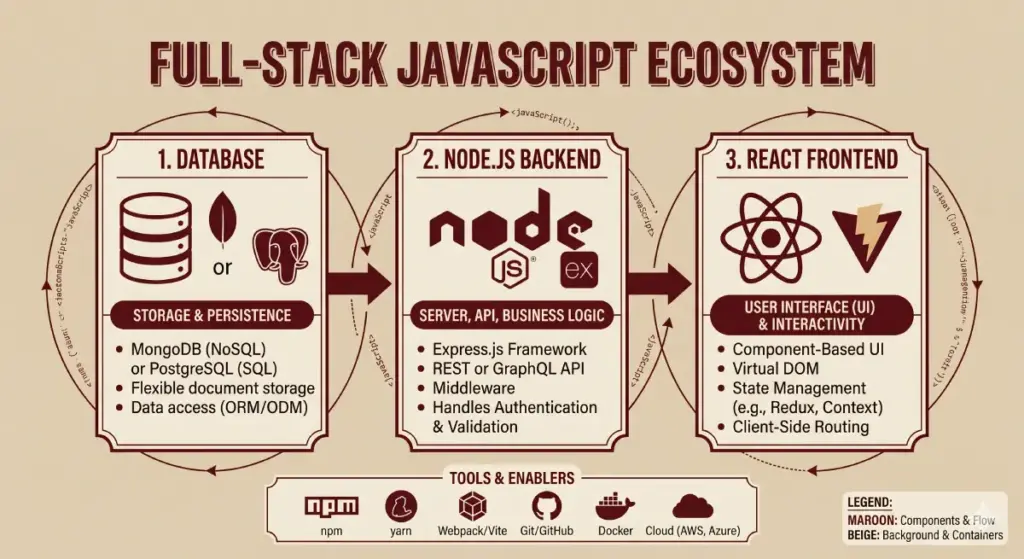
3. Seamless Data Flow with Modern Databases
In a traditional setup, developers waste countless hours translating data back and forth between different programming languages and rigid database structures. By utilizing a NoSQL database like MongoDB alongside Node.js and React, the entire application speaks a single language: JavaScript (and JSON).
Data flows seamlessly from the database, through the backend logic, and straight to the user’s screen in one cohesive format. This unified structure drastically reduces the potential for bugs, simplifies the debugging process, and allows for rapid iteration when you need to add new features or pivot your business strategy.
4. The Business Value of a Unified Ecosystem
Beyond the technical specifications, building with this stack offers a massive business advantage: velocity. Because the entire application relies on a unified JavaScript ecosystem, development teams can work cross-functionally with far greater synergy. Code can be shared and reused across the frontend and backend, testing becomes more streamlined, and time-to-market is significantly accelerated. You spend less time wrestling with incompatible technologies and more time delivering value to your end-users.

Conclusion
At Guehi & Co., we don’t just write code; we architect premium solutions designed for long-term growth. We understand that your software is an investment that needs to scale alongside your business. By leveraging industry-leading technologies like React, Node.js, Express, and MongoDB, we ensure that the custom software we engineer today will remain robust, secure, and highly performant for years to come.
Ready to build software that performs flawlessly from the first click to the millionth user? Let’s talk about your technical roadmap.